De geschiedenis van de Concertzaal Wilhelmina in Haanrade
(voorheen Onderspekholz) is nog niet uitputtend op schrift gesteld, maar het
moet het centrum van cultuur en vertier in de regio geweest zijn. Het Kermis
bal en Carnavals Bal, beiden direct 3 dagen, vonden hier jaarlijks plaats, bij
de plaatselijke wielerkoersen was Concertzaal Wilhelmina het centrum, en volkstoneel, een strijkje en het muziekkorps
Caecilia traden hier keer op keer op. De heer Reijnders was zelf een fervent
duivenmelker, al behaalde hij op de duivenwedstrijd in zijn eigen concertzaal
geen prijs (6 dec. 1923, Limburger Koerier).
Daarnaast is hij regelmatig in het nieuws als imker en bijenhouder, tevens
organisator van de bijeenkomsten van de Kerkraadse Bijenhouders Bond, die
uiteraard vergaderde in Concertzaal Wilhelmina (23 juli 1927, Limburger koerier). De zaal dient men niet te verwarren met de Concertzaal
„Wilhelmina" aan de Hoofdstraat 13 te Schaesberg (in 1929) en de
concertzaal Wilhelmina te Rumpen/Brunssum (in 1926).
zaterdag 27 juni 2020
zondag 31 mei 2020
Het "Willy-Dohmen-Park"
Eerste pinksterdag, een fietstocht richting de tuin van
Dohmen in het Duitse stadje Ubach-Palenberg (niet de verwarren met het
nabijgelegen Ubachsberg, Ubach over Worms of Palemig). De tocht loopt via
Eygelshoven en Rimburg een stuk langs de meanderende Wurm via een Klangbrücke
bestaande uit een enorme spiraal waar aan de kanten holle buizen door de wind
tegen een stukje hout worden geslagen, ziedaar een oneindige bron van geluid (in
de krant vindt je dan ook direct een artikel: ‘Klangbrücke ist jetzt ein Fall
für den Bundesgerichtshof’ Aachener
zeitung 2012). Maar achter die brug ligt het park van Willy Dohmen, beroemd
door zijn rododendrons en schildpadden.
Nu waren die rododendrons net
uitgebloeid, en hebben we wel een schildpad gezien, maar was het iets anders
dat mij opviel. Willy Dohmen, zo lees ik in het in semi Fraktur gekalligrafeerd
schrift op een enorm bord, was ondernemer in de zand en kiezelstenen en heeft
daarmee een opvallende overeenkomst met Garcet en de tuin in Craubeek, alle
drie de mannen zaten in de steenhandel. Willy Dohmen begon na de oorlog met de
exploitatie van een zandput, en ergens eind jaren ’80 vormt hij eigenhandig dit
industrielandschap om tot een Engels landschapspark. Het zijn echter de
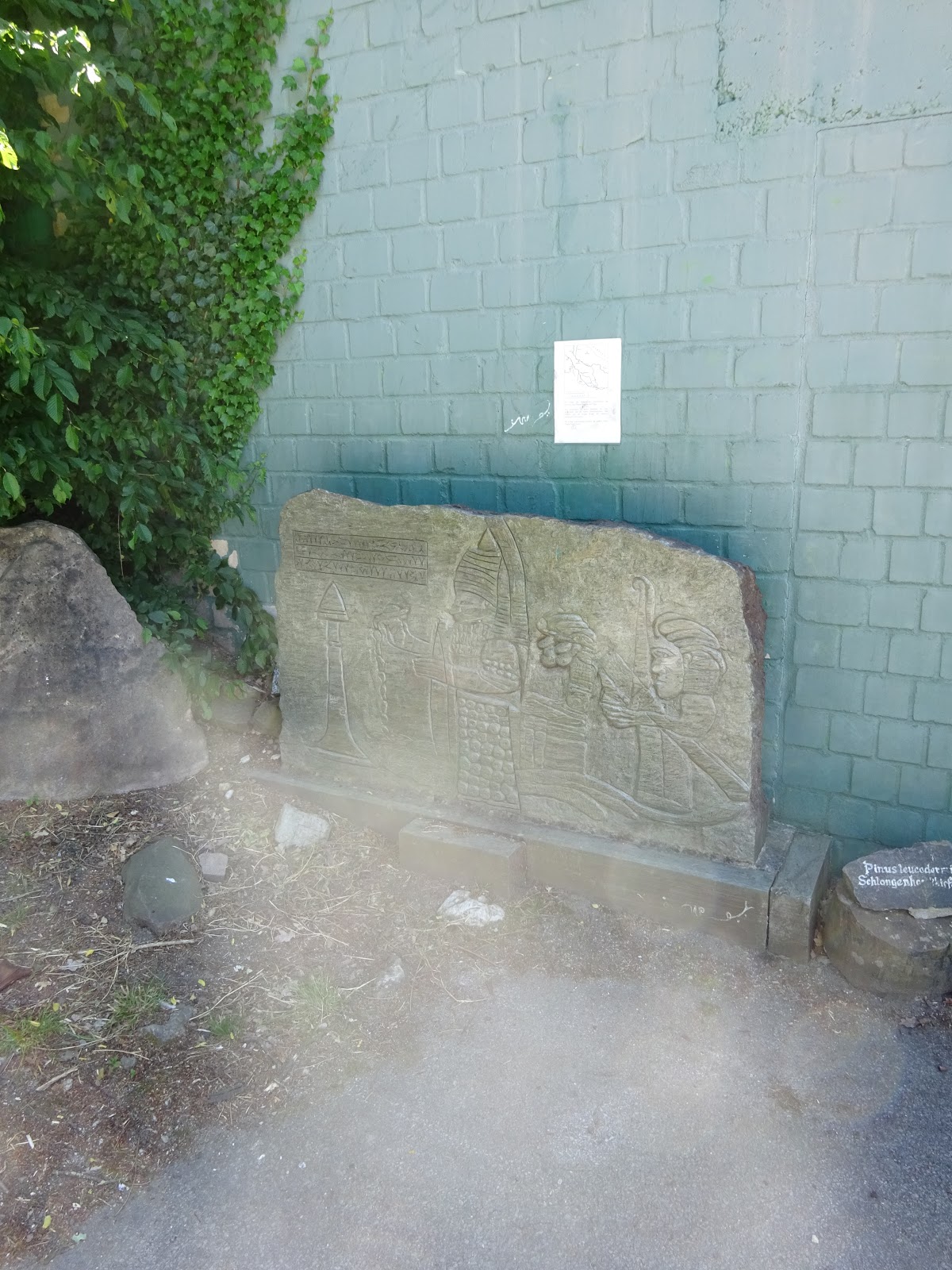
objecten waardoor mijn interesse werd gewekt. Op de zelfde bord met plattegrond
en informatie is te lezen (ik neem het hier over van de website): ‘Jupp
Schmölders, der beste Freund von Willy Dohmen und Kenner alter Kulturen, hat im
Park den umfangreichen Steingarten - mit kunstvoll eingemeißelten Informationen
für die Besucher über die Herkunft der Steine - angelegt und Maya-Skulpturen
nachgebildet.’ Het zijn niet alleen Maya-skulpturen die hier staan, alle stenenbrokken
hebben een naam erin gebeiteld gekregen, er staat ook een Paaseilanden beeld op
miniatuur formaat, en een steenblok staat er ter herinnering aan Otzi.
Bittere ernst moet het voor Jupp Schmölders geweest zijn, de Maya cultuur naar
dit dorpje te halen, ik denk dat zijn boekenkast vol heeft gestaan met de in
die periode hoog in groot aanzien staande Zwitserse geleerde Erich von Däniken. En
lange tijd liep ik hoofdschuddend langs de artefacten, schoolmeesterachtige
tekstjes, niet op hun plaats staande beelden, zelfs een museum voor
geschiedenis en stenen in een uithoek van het park. Tot ik bijna tegen een enorme
struik aan liep, kunstig gesnoeid, en enorme Marsupilami met Pokémon-trekken en
duivels horentjes of mogelijk de mascotte van de lokale carnavalsvereniging, een
tuinsculptuur op grond waarvan ik enkel kon concluderen dat de vrijwilligers en
de stichting die het park nu beheren de zaak ook niet helemaal serieus nemen,
een vleugje relativering naast al deze bittere ernst over de vraag of de goden
kosmonauten waren en andere onopgeloste raadsels uit het verleden. Een omweg is deze visionaire beeldentuin echter zeker waard, zolang we niet naar Hauterives mogen en zelfs niet naar Eben-Emael.
B.D. 31 maart 2020
MARCEL DUCHAMP (American-French, 1887-1968)
Chocolate Grinder No. 2
(Broyeuse de Chocolat 1914)
Het Otzi monument
http://www.willy-dohmen.de/wir/natur/natur.htm
-- -- -- -- -- -- --
Today, I
made a bike trip to the garden of Dohmen in the German town of Ubach-Palenberg
(not to be confused with nearby Ubachsberg, Ubach over Worms or Palemig).
Cycling via Eygelshoven and Rimburg along the river Wurm via a Klangbrücke
consisting of a huge spiral where hollow pipes that must be hit by the wind against
a piece of wood, this object is an endless source of sound (in the newspaper
you will find also an article that court cases are fought about the bridge:
'Klangbrücke ist jetzt ein Fall für den Bundesgerichtshof' Aachener zeitung 2012). But on the other side of that bridge is
Willy Dohmen's park, famous for its rhododendrons and turtles.
Well, those
rhododendrons had just finished flowering, and we have seen a turtle, but it
was something else I noticed. Willy Dohmen, as I read in the semi-Fraktur
calligraphy on a huge plate, was an entrepreneur in the sand and pebbles
business and therefore has a striking similarity with Garcet and the builder of
the sculpture garden in Craubeek, all three men were working in the stone
trade. Willy Dohmen started exploiting a sandpit after the war, and sometime
in the late 1980s he single-handedly transformed this industrial landscape into
an English landscape park. However, the
objects that really aroused my interest
were not his work. On the
same board with map and information you can read (I will copy it from the
website): ‘Jupp Schmölders, der beste
Freund von Willy Dohmen und Kenner alter Kulturen, hat im Park den
umfangreichen Steingarten - mit kunstvoll eingemeißelten Informationen für die
Besucher über die Herkunft der Steine - angelegt und Maya-Skulpturen
nachgebildet.’ [Jupp Schmölders, the best friend of Willy
Dohmen and a connoisseur of ancient cultures created the extensive rock garden
in the park - with artfully carved information for visitors about the origin of
the stones - and recreated Mayan sculptures.]
There are
not only Maya sculptures, all the rocks have been given a name, there is also
an Easter Island statue in miniature format, and a stone block in memory of
Otzi. It must have been bitter seriousness for Jupp Schmölders to bring the
Mayan culture to this village, I think that his bookcase was full of the at
that time highly regarded Swiss scholar Erich von Däniken. And for a long time
I was not too impressed by the artifacts, schoolmaster-like texts, out-of-place
statues, even a museum of history and stones in a corner of the park. Until I
almost ran into a huge bush, artfully pruned, a huge Marsupilami with Pokémon
traits and devil horns or possibly the mascot of the local carnival
association, a garden sculpture on the basis of which I could only conclude
that the volunteers and the foundation that runs the park nowadays do not to
take the matter too seriously either, adding a touch of perspective to all this
seriousness about the question of whether the gods were cosmonauts and other
unsolved mysteries from the past. Nonetheless, this visionary sculpture garden
is certainly worth a detour, as long as we are not allowed to travel to
Hauterives or even to Eben-Emael.
donderdag 23 april 2020
Craubeek
Op weg naar een appelboerderij kom ik aan het einde van het dorp Craubeek – een lintbebouwing van honderden meters die zich door het mergelland wringt. Hier liggen een paar
volkstuintjes en een met hoge struiken omheint perceel waar tientallen beelden
staan. Een bordje waarschuwt dat er camera bewaking is, een gammel hangslot
belet de toegang, maar nergens is enige verwijzing te vinden over de maker of
verzamelaar van al deze hardstenen beelden en gegoten betonnen paardenkoppen. Een
Tiki van de Paaseilanden en de kikker van Brisset staat vredig zij aan zij met
enkele Boeddha’s, Maria, en daarnaast de zittende schrijver uit Egypte (die ook voorkomt
in Dr. Faustroll). Een beer kijkt stuurs voor zich uit op een hoge sokkel, er
naast staan de uilen van Jarry. Helemaal achter in de tuin is een miniatuur
tempelcomplex van Borobudur nagebouwd, gekroond door een blauwe madonna. De overdaad
aan sokkels doet vermoeden dat de maker
zijn werken graag terug zou zien in een museale opstelling, de veelheid aan
stijlen geeft de indruk van een dozijn beeldhouwers die aan het werk zijn
geweest, zo zonder het verhaal er achter is het dus lastig een inschatting te
maken van de beweegredenen van de maker van deze visionaire beeldentuin. Maar
het blijft verwonderen, de beeldentuin van Felix Senden is de
fietstocht waard.
B.D., 23 april 2020
het is voorbij met de plek (5 9 2020)
Een opname en gesprek met de maker https://l1.nl/beeldig-tuintje-in-voerendaal-16697
Barrier
Barrier
In het vuistdikke naslagwerk van J.F. van Agt, Zuid-Limburg uitgezonderd Maastricht (Staatsdrukkerij-
en Uitgeverijbedrijf, Den Haag 1962) is te lezen dat de schutterij in Klimmen
onder de pronkstukken een ‘Houten trom, xviii, hoog 44, beschilderd met een
gekroond wapenschild waarop een rood monogram cmc, schildhouders twee
wildemannen, aanhangend een keten, waaraan olifant met draagstoel’ bezit (p.
363). Die olifant staat iets verder in het dorp fier aan de weg, in beton
gegoten. Aan de voet van de Klimmenderberg, een kilometer ten oosten van
Klimmen waar ik wat lokaal fruit hoop te kopen, ligt een groepje boerderijen en een aantal huizen. De naam Barrier
herinnert aan de slagboom van de voormalige tol aan de weg Maastricht-Heerlen. Hier
is een aanzet gemaakt voor een dierentuin,
met ganzen, struisvogels, vorig jaar stond er nog en verdwaalde lama die ik
vandaag niet terug kon vinden. De betonnen leeuwen liggen naast de poort, een
rechter oor mist. Het is te betreuren dat de toegangshekken gesloten zijn, niet
enkel wegens de heersende corona. In de lokale krant is te lezen dat het huis
naast de dierentuin vorig jaar gesloten is door de burgemeester na een
drugsvondst, maar de krant weet te melden dat de ‘dierentuin’ open mag blijven en dieren voer
zullen krijgen, behalve die olifant en leeuwen natuurlijk (De Limburger, 18 juli 2019).
De olifant is niet slecht, iets kleiner als die bij het
Droomkasteel aan de Ganzeweide op
Heerlerheide. De dolfijnen in de ganzenvijver kunnen als voorbeeld voor een tattoo dienen, de
leeuwen lijken uit een en de zelfde mal te komen, maar de twee figuren – een hoofd
ontbreekt - die iets verderop op het perceel
staan doen toch vermoeden dat we hier te maken hebben met een belangwekkend
stuk outsiderkunst, een bescheiden ‘environnement visionnaire’, zij het met
enig achterstallig onderhoud.
Fantastisch is natuurlijk de betonnen aap in de trapauto,
met platte banden, muurvast in de modder, is het gestand als de as van Dr. Faustroll
tijdens de landvaart, waarbij de cynocephale baviaan Bosse-de-Nage als matroos
de bezoekers olijk toe aapt, Haha!
dinsdag 31 maart 2020
wasknijperclub
De wasknijperclub in Palermo, maart 2020
Het veldonderzoek voor
de wasknijperclub in Palermo in maart 2020 had uiteraard wetenschappelijker
kunnen zijn. Waar vallen de wasknijpers, welke blijven heel, is iedere kleur te
vinden, zijn er verschillende formaten, is er een balkon met waslijn boven de
plek waar de wasknijper ligt (om het bekende spreekwoord te verifiëren: de
wasknijper valt niet ver van de boom). Nee, in feite ging het daar de wasknijperclub niet om. De wasknijper vervulde zelfs enkel een bijrol. Ter herinnering, de wasknijperclub i.o. richt
zich op de instandhouding van het detail
in het menselijk bestaan. De wasknijper is daar een element van. Van gelijk
belang is een papiertje op straat, het lijkt op een boodschappenlijstje, maar
door de vervaagde grijze letters mogelijk een gedicht. Of een stuk plastic, een
onderdeel, van en kinderspeelgoed. Natuurlijk niet bij de plekken waar afval
verzameld wordt, dat zou te eenvoudig zijn. Gewoon, op de stenen gevallen, op
de plek waar het op de straat achtergelaten is.
B.D.
THE CLOTHESPIN CLUB IN PALERMO, MARCH 2020
The field research for the Dutch (or better, Heerlen) Clothespin Club in Palermo in March 2020 could, of course, have been conducted in a more scientific way. Where do the clothespins fall, which remain intact, is it possible to trace every color, are there different sizes and models, is there a balcony with a clothesline above the place where the clothespin is found (to verify the well-known proverb: the clothespin does not fall far from the tree). No, in fact, that is not what the Clothespin Club was about. The clothespin even only played a supporting role. As a reminder, the Clothespin Club in formation focuses on the maintenance of detail in everyday life. The clothespin is only an element. Equally important is a fragment of paper on the street, it looks like a shopping list, but the faded gray letters may turn it into a poem. Or a piece of plastic, a part of a children's toy. Of course not objects found at the places where waste is collected, that would be too simple. Just fallen on the pavement, photographed where it was left derelict on the street.
zondag 22 maart 2020
Stille Omgang
I
In
1926, Louis Aragon sent André Breton a letter with a photo of a part of the
painting La Profanation de l'Hostie.
This painting by the Italian Renaissance painter Paolo Uccello consists of six
separate panels. These scenes tell the story of the desecration of the Sacramental
bread by a Jew. The story of Uccello's painting is naively painted like the
Epinal engravings, it tells a story like in comics and on the Bayeux tapestry. The
correspondence with Epinal engravings establishes a direct line between the
photo received and the plates and prints sold by the peddler, a man whom Nadja
and Breton meet a few days later in a restaurant.
The
photo Breton received shows the second panel: there is a Sacramental bread is
on the fire, some people are in a room, and soldiers are trying to force the
door of the room. Breton receives the image on October 8, when he dwells trough
Paris with Nadja, as described in the book with the same name. The evening of
the seventh runs towards the end when Nadja exclaims: ‘Que ce baiser la laisse
sous l’impression de quelque chose de sacré, où ses dents « tenaient lieu
d’Hostie ».’[1]
The
burning, but not burning Sacramental bread on Uccello's painting is like the flaming
hand above the Seine seen by Nadja.[2] Like the burning /
non-burning objects in the paintings of Dali and Magritte. Remarkably, in Breton
description, both of Nadja's Sacramental bread / teeth and the reference to
Uccello's scene are not anti-clerical, but strictly objective. The teeth
transform into a Sacramental bread, as we see a transformation in the movie Le
Chien Andalou, where a butterfly and armpit hair take the place of the mouth,
well, there is the French expression ‘Prendre l'hostie à la chapelle’. The
burning Sacramental bread elevates the sacral almost pubescent image of the
kiss / Sacramental bread.[3]
The
painting and its subject also bring a theme into the book, as a "ready
made". In addition to the "profanation de l'hostie", Breton
discusses the film L’étreinte de la
pieuvre [The trail of the octopus],
in which a Chinese tries to take over the dominion in America through
self-multiplication.[4] Both ready made topics – marginalized
Jews in medieval Italy and Chinese in America - treat xenophobia as everyday
examples of the then prevailing zeitgeist. Breton had a general aversion to the
Italian spirit all his life, he would never set foot on Italian soil where
fascism reigned most of his life, the more striking is his interest in Uccello.
André Breton wrote in his article Surrealism
yesterday, today, tomorrow,, published in the This Quarter magazine in 1932, that Uccello was surrealist ‘in the
free for all fight’.[5] Breton was not the only
one in his admiration for Uccello, Antonin Artaud was also impressed by
Uccello's painting, he published the article Uccello, Le Poil in La
Révolution Surréaliste of December 1, 1926. Some years later, in 1929 (ten
years after their Champs Magnétiques),
the former surrealist Philippe Soupault wrote a monograph in the series Maitres
de l’art Ancien about Paolo Uccello. Breton would return to Uccello in his Le Surréalisme et la Peinture (RS, no.
6, p. 30) and in 1949 he published the poem Sur
la route de San Romano, almost similar to the title of a painting by
Uccello: la Bataille de San Romano.
Nadja's
Sacramental bread does not stand alone in the writings of Breton. “Ma femme à
la langue d'hostie poignardée,” is a line in the poem L'Union Libre. Other surrealists
were fascinated by this object. Dali painted a Profanation de l'Hostie (1929). There is a priest in Thirion's Le Grand Ordinaire (1934), who is
present in the castle for the "Profanation de l'Hostie", Georges
Hugnet made a La profanation de l'hostie
(1935). The last to be mentioned is Pierre Mabille's description of this object
in Thérèse de Lisieux from 1937. So
far the Sacramental bread in some surrealist works.
Salvador
Dali, Profanation de l’hostie (1929)
-
100 x 73 cm -
Dalí
Museum, St. Petersburg, Florida
Salvador
Dali, Giraffe en feu (1936/1937)
René Magritte, La découverte du Feu (1936).
A similar composition appeared under the same title in Documents 1934.
De Stille Ommegang
II
The
painter J.H. Moesman started work on the painting De Stille Ommegang in 1935, the heyday of Dutch surrealism. In a
desert landscape an "Animal brut" walks with the hind legs of a lion
and the head of a pelican. Several themes recur in this painting, which place
this painting in the pivot of surrealist ideas.
In
addition, the title should get attention. The title was given to the painting
by the painter Fedde Weidema (1915 - 2000), and the usually stubborn Moesman
has accepted it. Giving titles to paintings by others is a practice that was
common practice in the group around René Magritte, where writers regularly gave
titles to paintings, titles that could be completely separate from the image.
In the Netherlands, where collective actions are virtually unknown, a
collaboration as described above in creating works and giving a title to a
painting is an exception. Comparable experiments are only known from the group
around De Schone Zakdoek magazine.
The
title is a reference to the Stille
Ommegang ("Silent Walk" or circumambulation), a Catholic procession in the city center of Amsterdam, known from
the 14th century and forbidden after the Protestant revolution. This custom was
restored by two people in 1881, and in the 1930s, ten thousand people
participated in this procession in March. The Stille Omgang commemorates the so called Miracle of Amsterdam. In
1345 a Sacramental bread floated above the fire in the home of an ill Amsterdammer.
Just before that, the Sacramental bread had been thrown into the fire with the
vomit of the man, and miraculously: the bread did not catch fire, as in the
painting by Uccello (and until the 19th century Catholics were marginalized
in The Netherlands).
After
the removal of several of his paintings from a exhibitions touching taboos in
Dutch society of the 1930ties, this title in with a Catholic connotation fits
in the line. Or maybe Moesman thought "Oh no, that animal just walks
around, "à pas de loups" it is a silent detour." Here we can
make a reference to the previous story in this series (Utrecht, 1713 &
André Breton): The 1713 Peace of Utrecht, in the words of Breton a ‘Paix pattes
de velours’ seems a reference to the words Breton wrote in Les Champs magnétiques: ‘Pneus pattes de velours’.[6] On March 31, 1963, Breton
and the other surrealists of the Parisian group gathered in the café, as usual
in the late afternoon. Here Arrabal, André Breton, George Goldfayn, Ragnar von
Holten, Radovan Ivsic, Alain Joubert, Joyce Mansour and José Pierre wrote a
brief and concise tribute to Moesman:
‘J.H. Moesman : trente ans durant une œuvre menée à pas de loup mais, au
sortir du bois, des tapis se déroulant à la rencontre d’une nouvelle hypotase
de la femme, ici gorgée d’insolite. D´un bouge voisin, par un soupirail,
s´élève la voix de Monsieur Bougrelon : « Hypothétique luxure, Messieurs !
Hypothétique luxure ! »’[7]
André Breton
Vente
Breton 2003, lot 2514
With
this Pelican Lion, a mythological animal has been created like the phoenix and
the griffin, and the Cameléopard from Apollinaire.[8] In addition, the pelican
and lion have an important role in the gnosis. The lion would eat the sun loosing
his head. The pelican ripped her body open to feed its young, and she has only
her head left. Do the two continue together in an unknown stage of the
transmutation of which the Sacramental bread itself is also an example?
We
see the interaction between truth and fiction in the whole story. The Sacramental
bread is a well-known example of this unity, and it is shown in Uccello's
painting and the Amsterdam example that the power of the people should not mock
this interaction. It is precisely within the philosophy of Breton and Moesman
that it is a challenge to place the truth and fiction as close together as
possible, so that an infra-thin field is created were these truths merge as
communicating vessels.
Moesman's
Stille Ommegang is a good example of
showing that Moesman was interested in the similar phenomena that haunted surrealists
in other countries - and these shared fascination form the surrealist movement,
not a simplified comparison of colors used, statues without legs or place of
the horizon in the composition.
Bastiaan
van der Velden
[Translated
and published on 22 march 2020; tonight this year’s Stille Omgang in Amsterdam
was cancelled]
[1] A. Breton, Œuvres complètes, tome I, p. 703.
[2] A. Breton, Œuvres complètes, tome I, p. 697.
[3] Brandend /
niet-brandende voorwerpen komen ook in schilderijen van surrealisten veelvuldig
voor. In de briefwisseling van René Magritte met Torczyner (Letters between friends (New York 1994)
p. 35) zette Magritte uiteen dat hij de ‘bedenker’ van de brandende objecten
was, maar dat Dali de publiciteitscampagne voor zichzelf beter organiseerde.
Dali schilderde een van zijn schilderijen met brandende giraffen in Wenen in
1936, enkele maanden voor de Anschluss, en dit schilderij met de titel ‘Les inventions des monstres’ had
volgens hem een profetisch karakter. In Dali zijn eigen woorden: ‘la giraffe en
feu [représentent] le monstre cosmique apocalyptique masculin’ (Dali, catalogus Boymans-van Beuningen,
Rotterdam 1970, schilderij no. 56). In 1938 verscheen Bachelard’s Psychoanalyse du Feu (Paris: Gallimard
1938). Hierin tracht hij niet het vuur, maar het kijken naar vuur te
onderzoeken, en analyseerde hij de wijze waarop het vuur – door wetenschappers
– beschreven was.
[4] A. Breton, Œuvres complètes, tome I, p. 633.
[5] This Quarter, II, n. 1, september 1932.
[6] A. Breton, Œuvres complètes, tome I, p. 65. En dat
veertien jaar voor het fameuze kopje van Méret Oppenheim.
[7] Monsieur Bougrelon is de titel van en de hoofdpersoon in een roman
van Jean Lorrain (1897) die zich in Amsterdam afspeelt.
[8] Apollinaire Œuvres complètes en prose, tome I, p.
842.
Abonneren op:
Posts (Atom)