zondag 31 mei 2020

Het "Willy-Dohmen-Park"


Eerste pinksterdag, een fietstocht richting de tuin van Dohmen in het Duitse stadje Ubach-Palenberg (niet de verwarren met het nabijgelegen Ubachsberg, Ubach over Worms of Palemig). De tocht loopt via Eygelshoven en Rimburg een stuk langs de meanderende Wurm via een Klangbrücke bestaande uit een enorme spiraal waar aan de kanten holle buizen door de wind tegen een stukje hout worden geslagen, ziedaar een oneindige bron van geluid (in de krant vindt je dan ook direct een artikel: ‘Klangbrücke ist jetzt ein Fall für den Bundesgerichtshof’ Aachener zeitung 2012). Maar achter die brug ligt het park van Willy Dohmen, beroemd door zijn rododendrons en schildpadden. 

Nu waren die rododendrons net uitgebloeid, en hebben we wel een schildpad gezien, maar was het iets anders dat mij opviel. Willy Dohmen, zo lees ik in het in semi Fraktur gekalligrafeerd schrift op een enorm bord, was ondernemer in de zand en kiezelstenen en heeft daarmee een opvallende overeenkomst met Garcet en de tuin in Craubeek, alle drie de mannen zaten in de steenhandel. Willy Dohmen begon na de oorlog met de exploitatie van een zandput, en ergens eind jaren ’80 vormt hij eigenhandig dit industrielandschap om tot een Engels landschapspark. Het zijn echter de objecten waardoor mijn interesse werd gewekt. Op de zelfde bord met plattegrond en informatie is te lezen (ik neem het hier over van de website): ‘Jupp Schmölders, der beste Freund von Willy Dohmen und Kenner alter Kulturen, hat im Park den umfangreichen Steingarten - mit kunstvoll eingemeißelten Informationen für die Besucher über die Herkunft der Steine - angelegt und Maya-Skulpturen nachgebildet.’ Het zijn niet alleen Maya-skulpturen die hier staan, alle stenenbrokken hebben een naam erin gebeiteld gekregen, er staat ook een Paaseilanden beeld op miniatuur formaat, en een steenblok staat er ter herinnering aan Otzi. Bittere ernst moet het voor Jupp Schmölders geweest zijn, de Maya cultuur naar dit dorpje te halen, ik denk dat zijn boekenkast vol heeft gestaan met de in die periode hoog in groot aanzien staande Zwitserse geleerde Erich von Däniken. En lange tijd liep ik hoofdschuddend langs de artefacten, schoolmeesterachtige tekstjes, niet op hun plaats staande beelden, zelfs een museum voor geschiedenis en stenen in een uithoek van het park. Tot ik bijna tegen een enorme struik aan liep, kunstig gesnoeid, en enorme Marsupilami met Pokémon-trekken en duivels horentjes of mogelijk de mascotte van de lokale carnavalsvereniging, een tuinsculptuur op grond waarvan ik enkel kon concluderen dat de vrijwilligers en de stichting die het park nu beheren de zaak ook niet helemaal serieus nemen, een vleugje relativering naast al deze bittere ernst over de vraag of de goden kosmonauten waren en andere onopgeloste raadsels uit het verleden. Een omweg is deze visionaire beeldentuin echter zeker waard, zolang we niet naar Hauterives mogen en zelfs niet naar Eben-Emael.


B.D. 31 maart 2020


MARCEL DUCHAMP (American-French, 1887-1968) 
Chocolate Grinder No. 2 
(Broyeuse de Chocolat 1914)
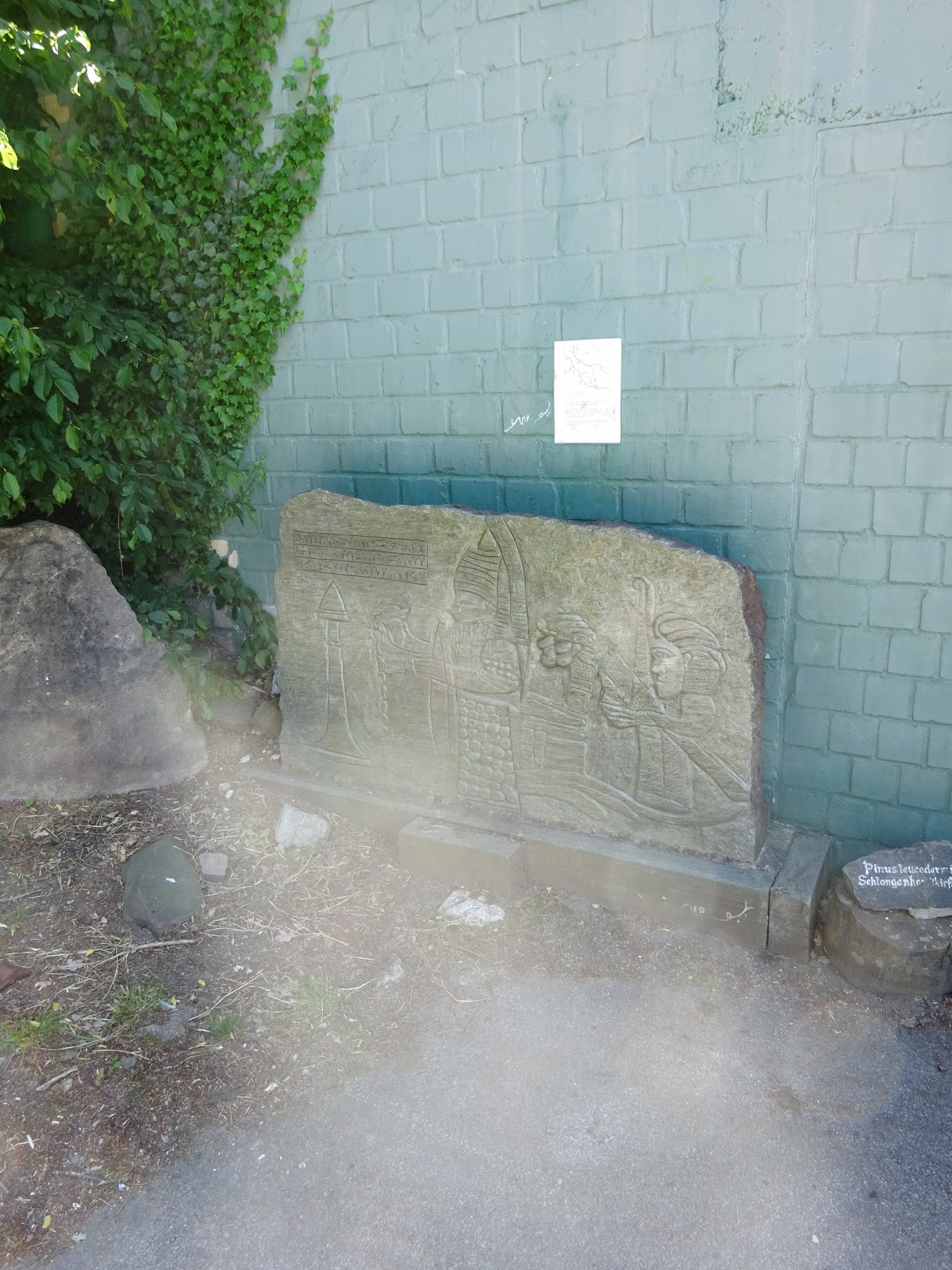


Het Otzi monument


http://www.willy-dohmen.de/wir/natur/natur.htm


-- -- -- -- -- -- -- 

Today, I made a bike trip to the garden of Dohmen in the German town of Ubach-Palenberg (not to be confused with nearby Ubachsberg, Ubach over Worms or Palemig). Cycling via Eygelshoven and Rimburg along the river Wurm via a Klangbrücke consisting of a huge spiral where hollow pipes that must be hit by the wind against a piece of wood, this object is an endless source of sound (in the newspaper you will find also an article that court cases are fought about the bridge: 'Klangbrücke ist jetzt ein Fall für den Bundesgerichtshof' Aachener zeitung 2012). But on the other side of that bridge is Willy Dohmen's park, famous for its rhododendrons and turtles.

Well, those rhododendrons had just finished flowering, and we have seen a turtle, but it was something else I noticed. Willy Dohmen, as I read in the semi-Fraktur calligraphy on a huge plate, was an entrepreneur in the sand and pebbles business and therefore has a striking similarity with Garcet and the builder of the sculpture garden in Craubeek, all three men were working in the stone trade. Willy Dohmen started exploiting a sandpit after the war, and sometime in the late 1980s he single-handedly transformed this industrial landscape into an English landscape park. However,  the objects that really  aroused my interest were not his work. On the same board with map and information you can read (I will copy it from the website):   ‘Jupp Schmölders, der beste Freund von Willy Dohmen und Kenner alter Kulturen, hat im Park den umfangreichen Steingarten - mit kunstvoll eingemeißelten Informationen für die Besucher über die Herkunft der Steine - angelegt und Maya-Skulpturen nachgebildet.’  [Jupp Schmölders, the best friend of Willy Dohmen and a connoisseur of ancient cultures created the extensive rock garden in the park - with artfully carved information for visitors about the origin of the stones - and recreated Mayan sculptures.]
There are not only Maya sculptures, all the rocks have been given a name, there is also an Easter Island statue in miniature format, and a stone block in memory of Otzi. It must have been bitter seriousness for Jupp Schmölders to bring the Mayan culture to this village, I think that his bookcase was full of the at that time highly regarded Swiss scholar Erich von Däniken. And for a long time I was not too impressed by the artifacts, schoolmaster-like texts, out-of-place statues, even a museum of history and stones in a corner of the park. Until I almost ran into a huge bush, artfully pruned, a huge Marsupilami with Pokémon traits and devil horns or possibly the mascot of the local carnival association, a garden sculpture on the basis of which I could only conclude that the volunteers and the foundation that runs the park nowadays do not to take the matter too seriously either, adding a touch of perspective to all this seriousness about the question of whether the gods were cosmonauts and other unsolved mysteries from the past. Nonetheless, this visionary sculpture garden is certainly worth a detour, as long as we are not allowed to travel to Hauterives or even to Eben-Emael.

donderdag 23 april 2020


Craubeek
 

Op weg naar een appelboerderij kom ik aan het einde van het dorp Craubeek – een lintbebouwing van honderden meters die zich door het mergelland wringt. Hier liggen een paar volkstuintjes en een met hoge struiken omheint perceel waar tientallen beelden staan. Een bordje waarschuwt dat er camera bewaking is, een gammel hangslot belet de toegang, maar nergens is enige verwijzing te vinden over de maker of verzamelaar van al deze hardstenen beelden en gegoten betonnen paardenkoppen. Een Tiki van de Paaseilanden en de kikker van Brisset staat vredig zij aan zij met enkele Boeddha’s, Maria, en daarnaast de zittende schrijver uit Egypte (die ook voorkomt in Dr. Faustroll). Een beer kijkt stuurs voor zich uit op een hoge sokkel, er naast staan de uilen van Jarry. Helemaal achter in de tuin is een miniatuur tempelcomplex van Borobudur nagebouwd, gekroond door een blauwe madonna. De overdaad aan sokkels doet vermoeden dat de  maker zijn werken graag terug zou zien in een museale opstelling, de veelheid aan stijlen geeft de indruk van een dozijn beeldhouwers die aan het werk zijn geweest, zo zonder het verhaal er achter is het dus lastig een inschatting te maken van de beweegredenen van de maker van deze visionaire beeldentuin. Maar het blijft verwonderen, de beeldentuin van Felix Senden is de fietstocht waard.  


B.D., 23 april 2020


het is voorbij met de plek (5 9 2020)


Een opname en gesprek met de maker https://l1.nl/beeldig-tuintje-in-voerendaal-16697

Barrier


Barrier


In het vuistdikke naslagwerk van J.F. van Agt, Zuid-Limburg uitgezonderd Maastricht (Staatsdrukkerij- en Uitgeverijbedrijf, Den Haag 1962) is te lezen dat de schutterij in Klimmen onder de pronkstukken een ‘Houten trom, xviii, hoog 44, beschilderd met een gekroond wapenschild waarop een rood monogram cmc, schildhouders twee wildemannen, aanhangend een keten, waaraan olifant met draagstoel’ bezit (p. 363). Die olifant staat iets verder in het dorp fier aan de weg, in beton gegoten. Aan de voet van de Klimmenderberg, een kilometer ten oosten van Klimmen waar ik wat lokaal fruit hoop te kopen, ligt een groepje boerderijen en een aantal huizen. De naam Barrier herinnert aan de slagboom van de voormalige tol aan de weg Maastricht-Heerlen. Hier  is een aanzet gemaakt voor een dierentuin, met ganzen, struisvogels, vorig jaar stond er nog en verdwaalde lama die ik vandaag niet terug kon vinden. De betonnen leeuwen liggen naast de poort, een rechter oor mist. Het is te betreuren dat de toegangshekken gesloten zijn, niet enkel wegens de heersende corona. In de lokale krant is te lezen dat het huis naast de dierentuin vorig jaar gesloten is door de burgemeester na een drugsvondst, maar de krant weet te melden dat de  ‘dierentuin’ open mag blijven en dieren voer zullen krijgen, behalve die olifant en leeuwen natuurlijk (De Limburger, 18 juli 2019).  

De olifant is niet slecht, iets kleiner als die bij het Droomkasteel aan de Ganzeweide op Heerlerheide. De dolfijnen in de ganzenvijver kunnen  als voorbeeld voor een tattoo dienen, de leeuwen lijken uit een en de zelfde mal te komen, maar de twee figuren – een hoofd ontbreekt -  die iets verderop op het perceel staan doen toch vermoeden dat we hier te maken hebben met een belangwekkend stuk outsiderkunst, een bescheiden ‘environnement visionnaire’, zij het met enig achterstallig onderhoud.

Fantastisch is natuurlijk de betonnen aap in de trapauto, met platte banden, muurvast in de modder, is het gestand als de as van Dr. Faustroll tijdens de landvaart, waarbij de cynocephale baviaan Bosse-de-Nage als matroos de bezoekers olijk toe aapt, Haha!

B.D., 23 april 2020


dinsdag 31 maart 2020

wasknijperclub


De wasknijperclub in Palermo, maart 2020


Het veldonderzoek voor de wasknijperclub in Palermo in maart 2020 had uiteraard wetenschappelijker kunnen zijn. Waar vallen de wasknijpers, welke blijven heel, is iedere kleur te vinden, zijn er verschillende formaten, is er een balkon met waslijn boven de plek waar de wasknijper ligt (om het bekende spreekwoord te verifiëren: de wasknijper valt niet ver van de boom). Nee, in feite ging het daar de  wasknijperclub niet om. De  wasknijper vervulde zelfs enkel een bijrol.  Ter herinnering, de wasknijperclub i.o. richt zich op  de instandhouding van het detail in het menselijk bestaan. De wasknijper is daar een element van. Van gelijk belang is een papiertje op straat, het lijkt op een boodschappenlijstje, maar door de vervaagde grijze letters mogelijk een gedicht. Of een stuk plastic, een onderdeel, van en kinderspeelgoed. Natuurlijk niet bij de plekken waar afval verzameld wordt, dat zou te eenvoudig zijn. Gewoon, op de stenen gevallen, op de plek waar het op de straat achtergelaten is.  

B.D. 


 THE CLOTHESPIN CLUB IN PALERMO, MARCH 2020

The field research for the Dutch (or better, Heerlen) Clothespin Club in Palermo in March 2020 could, of course, have been conducted in a more scientific way. Where do the clothespins fall, which remain intact, is it possible to trace every color, are there different sizes and models, is there a balcony with a clothesline above the place where the clothespin is found (to verify the well-known proverb: the clothespin does not fall far from the tree). No, in fact, that is not what the Clothespin Club was about. The clothespin even only played a supporting role. As a reminder, the Clothespin Club in formation focuses on the maintenance of detail in everyday life. The clothespin is only an element. Equally important is a fragment of paper on the street, it looks like a shopping list, but the faded gray letters may turn it into a poem. Or a piece of plastic, a part of a children's toy. Of course not objects found at the places where waste is collected, that would be too simple. Just fallen on the pavement, photographed where it was left derelict on the street.

zondag 22 maart 2020


Stille Omgang


I


In 1926, Louis Aragon sent André Breton a letter with a photo of a part of the painting La Profanation de l'Hostie. This painting by the Italian Renaissance painter Paolo Uccello consists of six separate panels. These scenes tell the story of the desecration of the Sacramental bread by a Jew. The story of Uccello's painting is naively painted like the Epinal engravings, it tells a story like in comics and on the Bayeux tapestry. The correspondence with Epinal engravings establishes a direct line between the photo received and the plates and prints sold by the peddler, a man whom Nadja and Breton meet a few days later in a restaurant.


The photo Breton received shows the second panel: there is a Sacramental bread is on the fire, some people are in a room, and soldiers are trying to force the door of the room. Breton receives the image on October 8, when he dwells trough Paris with Nadja, as described in the book with the same name. The evening of the seventh runs towards the end when Nadja exclaims: ‘Que ce baiser la laisse sous l’impression de quelque chose de sacré, où ses dents « tenaient lieu d’Hostie ».’[1]

The burning, but not burning Sacramental bread on Uccello's painting is like the flaming hand above the Seine seen by Nadja.[2] Like the burning / non-burning objects in the paintings of Dali and Magritte. Remarkably, in Breton description, both of Nadja's Sacramental bread / teeth and the reference to Uccello's scene are not anti-clerical, but strictly objective. The teeth transform into a Sacramental bread, as we see a transformation in the movie Le Chien Andalou, where a butterfly and armpit hair take the place of the mouth, well, there is the French expression ‘Prendre l'hostie à la chapelle’. The burning Sacramental bread elevates the sacral almost pubescent image of the kiss / Sacramental bread.[3]

The painting and its subject also bring a theme into the book, as a "ready made". In addition to the "profanation de l'hostie", Breton discusses the film L’étreinte de la pieuvre [The trail of the octopus], in which a Chinese tries to take over the dominion in America through self-multiplication.[4] Both ready made topics – marginalized Jews in medieval Italy and Chinese in America - treat xenophobia as everyday examples of the then prevailing zeitgeist. Breton had a general aversion to the Italian spirit all his life, he would never set foot on Italian soil where fascism reigned most of his life, the more striking is his interest in Uccello. André Breton wrote in his article Surrealism yesterday, today, tomorrow,, published in the This Quarter magazine in 1932, that Uccello was surrealist ‘in the free for all fight’.[5] Breton was not the only one in his admiration for Uccello, Antonin Artaud was also impressed by Uccello's painting, he published the article Uccello, Le Poil in La Révolution Surréaliste of December 1, 1926. Some years later, in 1929 (ten years after their Champs Magnétiques), the former surrealist Philippe Soupault wrote a monograph in the series Maitres de l’art Ancien about Paolo Uccello. Breton would return to Uccello in his Le Surréalisme et la Peinture (RS, no. 6, p. 30) and in 1949 he published the poem Sur la route de San Romano, almost similar to the title of a painting by Uccello: la Bataille de San Romano.
Nadja's Sacramental bread does not stand alone in the writings of Breton. “Ma femme à la langue d'hostie poignardée,” is a line in the poem L'Union Libre. Other surrealists were fascinated by this object. Dali painted a Profanation de l'Hostie (1929). There is a priest in Thirion's Le Grand Ordinaire (1934), who is present in the castle for the "Profanation de l'Hostie", Georges Hugnet made a La profanation de l'hostie (1935). The last to be mentioned is Pierre Mabille's description of this object in Thérèse de Lisieux from 1937. So far the Sacramental bread in some surrealist works.


Salvador Dali, Profanation de l’hostie (1929)
- 100 x 73 cm -
Dalí Museum, St. Petersburg, Florida


Salvador Dali, Giraffe en feu (1936/1937)


 René Magritte, L´échelle de feu (1939)


René Magritte, La découverte du Feu (1936). 
A similar composition appeared under the same title in Documents 1934. 


De Stille Ommegang 
II

The painter J.H. Moesman started work on the painting De Stille Ommegang in 1935, the heyday of Dutch surrealism. In a desert landscape an "Animal brut" walks with the hind legs of a lion and the head of a pelican. Several themes recur in this painting, which place this painting in the pivot of surrealist ideas.


J.H. Moesman, De Stille Ommegang, 1935

First, the design; the preliminary design of the painting is a cadavre exquis (a piece of paper is folded in half, the participants make a drawing on one part, without knowing what the other has made or is going to draw). The cadavre exquis was created by the writer Anton Koolhaas, (1912 - 1992) who gave the assist, and Moesman who responded. One side of the paper has the drawing of a Pelican Lion, the other side contains a Pig Elephant. This suggests that an agreement was made to draw animals, which is at odds with the premise that the cadavre is made automatically and without any rule or predefined theme.

In addition, the title should get attention. The title was given to the painting by the painter Fedde Weidema (1915 - 2000), and the usually stubborn Moesman has accepted it. Giving titles to paintings by others is a practice that was common practice in the group around René Magritte, where writers regularly gave titles to paintings, titles that could be completely separate from the image. In the Netherlands, where collective actions are virtually unknown, a collaboration as described above in creating works and giving a title to a painting is an exception. Comparable experiments are only known from the group around De Schone Zakdoek magazine.

The title is a reference to the Stille Ommegang ("Silent Walk" or circumambulation), a Catholic procession in the city center of Amsterdam, known from the 14th century and forbidden after the Protestant revolution. This custom was restored by two people in 1881, and in the 1930s, ten thousand people participated in this procession in March. The Stille Omgang commemorates the so called Miracle of Amsterdam. In 1345 a Sacramental bread floated above the fire in the home of an ill Amsterdammer. Just before that, the Sacramental bread had been thrown into the fire with the vomit of the man, and miraculously: the bread did not catch fire, as in the painting by Uccello (and until the 19th century Catholics were marginalized in The Netherlands).
After the removal of several of his paintings from a exhibitions touching taboos in Dutch society of the 1930ties, this title in with a Catholic connotation fits in the line. Or maybe Moesman thought "Oh no, that animal just walks around, "à pas de loups" it is a silent detour." Here we can make a reference to the previous story in this series (Utrecht, 1713 & André Breton): The 1713 Peace of Utrecht, in the words of Breton a ‘Paix pattes de velours’ seems a reference to the words Breton wrote in Les Champs magnétiques: ‘Pneus pattes de velours’.[6] On March 31, 1963, Breton and the other surrealists of the Parisian group gathered in the café, as usual in the late afternoon. Here Arrabal, André Breton, George Goldfayn, Ragnar von Holten, Radovan Ivsic, Alain Joubert, Joyce Mansour and José Pierre wrote a brief and concise tribute to Moesman:

‘J.H. Moesman : trente ans durant une œuvre menée à pas de loup mais, au sortir du bois, des tapis se déroulant à la rencontre d’une nouvelle hypotase de la femme, ici gorgée d’insolite. D´un bouge voisin, par un soupirail, s´élève la voix de Monsieur Bougrelon : « Hypothétique luxure, Messieurs ! Hypothétique luxure ! »’[7]                    
André Breton


Vente Breton 2003, lot 2514

With this Pelican Lion, a mythological animal has been created like the phoenix and the griffin, and the Cameléopard from Apollinaire.[8] In addition, the pelican and lion have an important role in the gnosis. The lion would eat the sun loosing his head. The pelican ripped her body open to feed its young, and she has only her head left. Do the two continue together in an unknown stage of the transmutation of which the Sacramental bread itself is also an example?

We see the interaction between truth and fiction in the whole story. The Sacramental bread is a well-known example of this unity, and it is shown in Uccello's painting and the Amsterdam example that the power of the people should not mock this interaction. It is precisely within the philosophy of Breton and Moesman that it is a challenge to place the truth and fiction as close together as possible, so that an infra-thin field is created were these truths merge as communicating vessels.

Moesman's Stille Ommegang is a good example of showing that Moesman was interested in the similar phenomena that haunted surrealists in other countries - and these shared fascination form the surrealist movement, not a simplified comparison of colors used, statues without legs or place of the horizon in the composition.

Bastiaan van der Velden

[Translated and published on 22 march 2020; tonight this year’s Stille Omgang in Amsterdam was cancelled]


[1] A. Breton, Œuvres complètes, tome I, p. 703.
[2] A. Breton, Œuvres complètes, tome I, p. 697.
[3] Brandend / niet-brandende voorwerpen komen ook in schilderijen van surrealisten veelvuldig voor. In de briefwisseling van René Magritte met Torczyner (Letters between friends (New York 1994) p. 35) zette Magritte uiteen dat hij de ‘bedenker’ van de brandende objecten was, maar dat Dali de publiciteitscampagne voor zichzelf beter organiseerde. Dali schilderde een van zijn schilderijen met brandende giraffen in Wenen in 1936, enkele maanden voor de Anschluss, en dit schilderij met de titel ‘Les inventions des monstres’ had volgens hem een profetisch karakter. In Dali zijn eigen woorden: ‘la giraffe en feu [représentent] le monstre cosmique apocalyptique masculin’ (Dali, catalogus Boymans-van Beuningen, Rotterdam 1970, schilderij no. 56). In 1938 verscheen Bachelard’s Psychoanalyse du Feu (Paris: Gallimard 1938). Hierin tracht hij niet het vuur, maar het kijken naar vuur te onderzoeken, en analyseerde hij de wijze waarop het vuur – door wetenschappers – beschreven was.
[4] A. Breton, Œuvres complètes, tome I, p. 633.
[5] This Quarter, II, n. 1, september 1932.
[6] A. Breton, Œuvres complètes, tome I, p. 65. En dat veertien jaar voor het fameuze kopje van Méret Oppenheim.
[7] Monsieur Bougrelon is de titel van en de hoofdpersoon in een roman van Jean Lorrain (1897) die zich in Amsterdam afspeelt.
[8] Apollinaire Œuvres complètes en prose, tome I, p. 842.

zaterdag 21 maart 2020


Bonbons Hollandais[1]

       ‘Contrairement à l’ordinaire, je choisis de suivre le trottoir droit de la rue de la Chaussée-d’Antin. Une des premières personnes que je m’apprête à y croiser est Nadja, sous son aspect du premier jour. Elle s’avance comme si elle ne voulait pas me voir. Comme le premier jour, je reviens sur mes pas avec elle. Elle se montre assez incapable d’expliquer sa présence dans cette rue où, pour faire trêve à de plus longues questions, elle me dit être à la recherche de bonbons hollandais.’
                               André Breton, Nadja (6 octobre)[2]


The Bonbons Hollandais Nadja was looking for in this quote kept me busy for some time in and around 1995. I was  unable to find them. No dictionary could translate the words. There is no more a candy store in the Parisian rue de la Chaussée-d'Antin, only whores on the street, but even they were disappearing from the  scene in this neighborhood, none of my French friends could, even after long and frequent inquiries, tell what the Bonbons Hollandais were. In the Dutch translation of Nadja the translation "Haagse Hopjes" is chosen.[3] However, these Hopjes are according to the richly decorated boxes in which they were sold "bonbons au café". In the English translation Nadja is looking for ‘Dutch Chocolate’.[4]  So Nadja was looking for candies that I try to find sixty-five years later in vain. Could it be that Nadja was not looking for sweets, but something else, that this term is a euphemism? A day after the meeting between Nadja and Breton in rue de la Chaussée-d'Antin, Nadja told Breton:

‘Une seule fois, je me suis trouvée en possession de vingt-cinq mille francs, que mon ami m’avait laissés. On m’a assuré qu’en quelques jours il m’était très facile de tripler cette somme, à condition d’aller l’échanger à La Haye contre de la cocaïne.’[5]

Nadja is arrested by the police, who confiscate almost all contraband: ‘j’ai oublié de signaler que tout n’était pas dans mon sac, qu’il fallait aussi chercher sous le ruban de mon chapeau. Mais ce qu’on eût trouvé n’en valait pas la peine. Je l’ai gardé pour moi.’[6]  Nadja transported a total of almost two kilos of cocaine with a street value of almost 175,000 Euros nowadays. It was not really surprising that she traveled to The Hague for this. The Netherlands was one of the largest producers of this stuff, because the Dutch East Indies had the ideal climate for this branch of agriculture.[7] In the early 1900s, cocaine was quite popular. For example, Sigmund Freud sent a few grams to his girlfriend, with the accompanying letter instructing him to make 8 to 5 servings. One would become a wild man, with all that cocaine in the body. Were those Bonbons Hollandais perhaps a euphemism or argot for cocaine? My uncle immediately came up with the title of a song by the Rolling Stones: Brown Sugar [ https://www.youtube.com/watch?v=59K2kF6o9Tk ]. Was she looking for cocaine for her own use?


The case of the Bonbons Hollandais can also be solved in another way. Breton lent some of his books to Nadja, including Les pas perdus. In this book, published in 1924, he collected essays on art and literature.

‘J’ai observé en la rencontrant qu’elle tenait à la main l’exemplaire des Pas perdus que je lui ai prêté. Il est maintenant sur la table et, à en apercevoir la tranche, je remarque que quelques feuillets seulement en sont coupés. Voyons : ce sont ceux de l’article intitulé : « L’esprit nouveau »’[8]

Breton here pretends that only the pages of the article ‘L’esprit nouveau’ were cut open. However, when Breton gave Les pas perdus and  Manifeste du surréalisme to Nadja, the whole book was cut open:

‘Elle feuillette l’ouvrage avec grande curiosité. Son attention se fixe sur un poème de Jarry qui y est cité :

       Parmi les bruyères, pénil des menhirs...’[9]


Les pas perdus, like most French books of this period, consists of folded pages making a signature that the reader had to cut open before he could read the contents. In the first edition of the book I consulted, Jarry's quote is exactly on the outside of a signature, so it was not necessary to cut the book open to read this part. Nevertheless, Breton wrote that Nadja leafed through the book, indicating that the book had been cut open. Could it be possible that while browsing  Les pas perdus, Nadja  read the article about the poet Guillaume Apollinaire, which is just before the piece on Jarry? Here you can read:

       ‘Songer alors : Guillaume Apollinaire est canonnier à Nîmes, me donnait toute la mesure du bouleversement.
                   La plate vie de garnison ne parvient pas à lui déplaire. Pour la poésie, il y a les chevaux à nommer, les relations nouvelles et les inscriptions des rues. Il y a surtout l’espoir du beau lendemain.

                               La grande force est le désir

       et je ne vois en tout ceci aucune contrainte Accordons plutôt au poète un don prodigieux d’émerveillement. C’est le même qui, boulevard Montmorency, attendra de Jean Royère des crayons de couleur et des bonbons hollandais.’[10]

Is it possible that Nadja has read more pages in Les pas perdus, not just the piece André Breton writes about in the text of 6 October? Did Nadja start looking for the Bonbons Hollandais, as I went searching for it?

[addendum anno 2020]
Today it is possible to search for almost everything on the web. ‘Brown sugar’ gives all the necessary images, but the Bonbons Hollandais are more difficult to be found, in a French magazine on food I discovered a short text, but  even here the author of this Q&A starts with a disclaimer ‘Bonbons hollandais (Hopjès). M. Wilfr..., Clam..., Angl. — C'est sans doute aux Hopjès auxquels vous faites allusion dans votre demande, sous votre désignation de « bonbons hollandais ». Ce sont là des spécialités qui sont fabriquées surtout par deux très grandes et sérieuses maisons hollandaises qui portent le même nom soit « Rademaker ». Maisons dont les produits sont impeccables et qui gardent fort jalousement leurs secrets de fabrication.’ (La Pâtisserie française illustrée, 1938/04)


[1] L’Aigle Bleu, no. 4, août 1996.
[2] Breton, Œuvres complètes, tome I, p. 691.
[3] Breton, Nadja, Nederlandse vertaling door L. Vancrevel en R. de Jong-Belifante (Amsterdam 1973) p. 64.
[4] Breton, Nadja, Engelse vertaling door R. Howard (New York/London 1960) p. 77.
[5] Breton, Œuvres complètes, tome I, p. 702.
[6] Breton, Œuvres complètes, tome I, p. 702.
[7] M. de Kort et D.J. Korf : ‘Hollandse prioriteiten. De ontwikkeling van de drugshandel en de opkomst van de narcotica bestrijding in Nederland’, in: Tijdschrift voor criminologie, 1990, no. 1 p. 13-32.
[8] André Breton, Nadja (6 octobre); Œuvres complètes, tome I, p. 691.
[9] André Breton, Nadja (5 octobre); Œuvres complètes, tome I, p. 689.
[10] André Breton, ‘G. Apollinaire’, in: Les Pas perdus.